Scholarly Citations
 Religious Liberty in America has been cited or quoted in the following scholarly publications and articles:
Law journals
Religious liberty and contraceptives
Jonathan T. Tan of the University of Richmond School of Law cites Religious Liberty in America in his law review article, “Nonprofit Organizations, For-Profit Corporations, and the HHS mandate: Why the Mandate Does Not Satisfy RFRA’S Requirements.” The article discusses the Department of Health and Human Services’ rules requiring for-profit and nonprofit employers to cover contraceptive services, in the context of the Religious Freedom Restoration Act. 47 U. Rich. L. Rev. 1301.
Free exercise in the workplace
In an article discussing religious diversity in the New Zealand workforce, Prof. Paul Morris references Religious Liberty in America in his comparative study of religious rights in countries based on English common law. Human Rights Research Journal, Victoria University of Wellington, New Zealand, Vol. 6, 2011.‘Originalism a weak foundation’
UC Davis Law Professor Alan Brownstein quotes Religious Liberty in America in his Cardozo Law Review article, “Originalism a Weak Foundation for Viewing Religious Liberty,” which discusses the problems with the "originalist" approach to interpreting the Religious Liberty Clauses of the First Amendment. 2009 Cardozo L. Rev. De Novo 196, 217.
Free exercise and exorcism
Cynthia Koploy cites Religious Liberty in America in her Northwestern University Law Review article, “Free Exorcise Clause: Can Exorcism Survive America's New Neutrality?” The article deals with the Free Exercise Clause and certain religious practices that can be considered extreme, such as exorcism. 104 Nw. U.L. Rev. 363, 389.
‘What Would the Founding Fathers Do?’
Susan Henderson-Utis cites Religious Liberty in America in her Howard Law Journal article, “What Would the Founding Fathers Do? The Rise of Religious Programs in the United States Prison System.” Henderson-Utis notes the influence of the philosopher Montesquieu on the Founding Fathers, citing Chapter 3 of Religious Liberty in America. 52 How. L.J. 459, 506.
Academic journals
Barack Obama's rhetoric and civil religion
Prof. David Howard-Pitney cites Religious Liberty in America in his review of
“Power in Words: The Stories behind Barack Obama’s Speeches, from the State House to the White House” by Mary Frances Berry and Josh Gottheimer. The Journal of African American History, Vol. 97, No. 3 (Summer 2012), pp. 291-302.
Charitable giving and the law
Brigham Young University Law Professor Brett Scharffs cites Religious Liberty in America in his article, “Volunteerism, Charitable Giving, and Religion: The U.S. Example.” Scharffs discusses how the structure of U.S. law fosters charitable giving; and how religious organizations are a focal point for philanthropy in America. The Review of Faith & International Affairs, Vol. 7, No. 3, Fall 2009.
The Journal of American History
Religious Liberty in America is noted in the journal's list of “recent scholarship.” Also see the History News Network.
Faith-Based Initiatives on Cpedia
Religious Liberty in America chronicles the development of government and faith-based partnerships — and how such partnerships are conducted under the mandate of separation of church and state. Noted in Cpedia, the automated encyclopedia from Cuil.
Books
Religious Liberty in Western and Islamic Law
Kristine Kalanges cites Religious Liberty in America in her 2012 Oxford University Press book, Religious Liberty in Western and Islamic Law: Toward a World Legal Tradition, which explores the comparative effects of religious beliefs and practices on constitutions and international human rights.
Mainline Christianity: The Past and Future
Jason S. Lantzer cites Religious Liberty in America in his book, Mainline Christianity: The Past and Future of America's Majority Faith (in the chapter, “The Politics of Decline.”)
Contours of Christianity in America
David J. Courey cites Religious Liberty in America in his book, What Has Wittenberg to Do with Azusa?: Luther's Theology of the Cross and and Pentecostal Triumphalism.
Academic papers
Black Churches and Faith-Based Initiatives
Nicole Steckman of Georgetown University cites Religious Liberty in America in her thesis paper examining the role of government in the delivery of social services through religious-based organizations. She examines whether one emerges as “controlling” the other.
More news on Religious Liberty in America
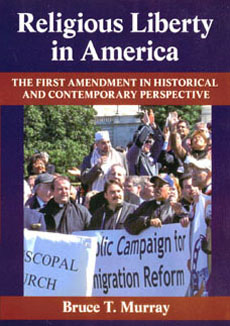
University of Massachusetts Press news
UMass Press books in the news
St. Cloud University News
Religious Liberty in America is one of about 700 books honored from a pool of about 7,000 books reviewed by the library journal.
Freedom of conscience, anti-censorship
The File Room lists Religious Liberty in America in its bibliography of anti-censorship resources. The File Room is hosted and maintained by the National Coalition Against Censorship.
‘In the news’ at California Western School of Law
CalWestern highlighted Murray's article, “Guns and Religion: Where and When Constitutional Rights Apply,” published in the Santa Barbara Independent.
Reviews of Religious Liberty in America
“By looking at the over 200-year history of the First Amendment and attempting to ‘distill the volumes of debate, background and case law into seven chapters,’ Murray presents an especially helpful depiction for his intended audience of students, journalists and general readers. ... Religious Liberty in America efficiently accomplishes its stated task to provide a non/ pre-scholarly audience with a thorough introduction to the history and contemporary circumstances concerning the First Amendment. Bruce T. Murray deserves praise for his success as a narrator.”
—Brandon M. Crowe, Ph.D., School of Historical, Philosophical and Religious Studies, Arizona State University
(from Reviews in Religion & Theology, History and Sociology of Religion, Wiley-Blackwell Publishing, Vol. 17, Issue 2, 2010)

“The book’s most important success is how well Murray connects current controversies with past events, always well positioned in the broader context of First Amendment religious freedom goals and objectives. As an example of this approach, he presents in a serious way the very idea of people of faith as mainstream Americans seeking opportunities through their religious practices to understand and give meaning to their lives.”
— Kurt Hohenstein, Director of Paralegal Program and Co-Director of Law & Society Program, Winona State University (from Humanities & Social Sciences, H-Law, November, 2010)
“In this book, the First Amendment is explored through historical documents, courtroom decisions, governmental policy, and its effects on the daily lives of people in America. Bruce T. Murray intends and succeeds in creating an introductory book which is managable and informative.”
— Elizabeth Tauba Ingenthron, Graduate Theological Union, Berkeley, Calif. (from the Anglican Theological Review, Vol. 92, No. 1, Winter 2010)
“This book provides an interesting history of religious liberty in America and helps provide context to the topic of this guide. Additionally, the book examines religious liberty in public schools and discusses the concept of neutrality as a guiding principle for the government’s relationship to religion.”
— Research Guide for Prof. Nancy Johnson's Advanced Legal Research class, Georgia State University College of Law
See more book reviews here, and also see book reviews focusing on the law.