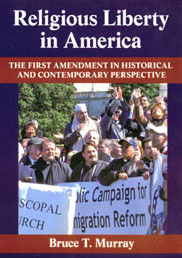
cover

Issues covered in Religious Liberty in America


Recent newsletters


Tracking America's ‘culture wars’
“America the sacred” and “America the secular” — Those who hold these two opposing ideologies have been locked in battle for decades. Their stakes: The nation's soul and the nation's freedom. The University of Massachusetts Press book, Religious Liberty in America: The First Amendment in Historical and Contemporary Perspective by Bruce T. Murray, analyzes the culture wars in the context of America’s longstanding debate over religion in public life. (Release date: May 30, 2010)

From gun rights to religious liberty
Justice Clarence Thomas believes that the First Amendment's Establishment Clause should not be “incorporated,” while other conservative members of the High Court are leaning toward incorporation the Second Amendment. Read an analysis here. (Release date: March 12, 2010; updated June 28, 2010)

In search of a ‘fixed star’
Courts diverge over the meaning of ‘separation of church and state’ – and how far this doctrine should be carried. The divergence in the courts reflects ambivalence in the broader society over the proper role of religion in public life. (Release date: May 4, 2010)

The First Freedom

First Amendment in review
The story of the First Amendment during the past decade is one of continual revision by the judiciary and significant expansion of executive authority. Author Bruce T. Murray explores the “First Liberty” – past and present – in the University of Massachusetts Press book, Religious Liberty in America: The First Amendment in Historical and Contemporary Perspective. (Release date: Jan. 1, 2009)

The Supreme Court

The Catholic Court?
Sonia Sotomayor’s appointment to the Supreme Court brings the number of Catholics on the Court to six (out of nine). What, if anything, will this mean for the direction of the Court? The University of Massachusetts Press book, Religious Liberty in America: The First Amendment in Historical and Contemporary Perspective by Bruce T. Murray, includes a chapter on the Supreme Court and analyzes the previous two appointees, John Roberts and Sam Alito. (Release date: Aug. 15, 2009)

Sonia Sotomayor confirmation
Judge Sonia Sotomayor was confirmed Aug. 6 as the 111th justice to the U.S. Supreme Court, with a decisive 68-31 vote in the Senate. Although the confirmation hearings provided an opportunity for Senators to posture for their constituents, they provided little insight into the prospective justices’ legal processes and reasoning.
(News releases: July 17, 2009 and Aug. 6, 2009)

Whither goes the Court?
Religious Liberty in America explores the Supreme Court’s evolution in its interpretation of the First Amendment for the past 200-plus years. (Release date: May 19, 2008)

Freedom of Conscience

Conscientious objection
Two university instructors who recently refused to sign the California State Oath of Allegiance have drawn attention to a key aspect of the First Amendment that is often overlooked – the issue of conscience. Religious Liberty in America explores the core element of the First Amendment. (Release date: May 5, 2008)

Religion and politics

Religious liberty and political civility
Political civility in America seems to have taken a dive southward, with a recent spate of rude outbursts, accusations and the ever-blaring talk shows. Often overlooked in the discussion is the role of the First Amendment and religious liberty in America’s civil discourse. The University of Massachusetts Press book, Religious Liberty in America: The First Amendment in Historical and Contemporary Perspective by Bruce T. Murray, explores the connection between religious liberty and political civility. (Release date: Sept. 23, 2009)

‘Not one of us’
An analysis of Sarah Palin's rhetoric. (Release date: Nov. 16, 2009)

Toxic mix? Book measures religion and politics
God and guns; religion and politics – they go together about as smoothly as drinking and driving; but nonetheless these are indelible facets of American society. Bruce T. Murray delves into these enduring features of American politics in his University of Massachusetts Press book, Religious Liberty in America: The First Amendment in Historical and Contemporary Perspective. (Release date: April 19, 2008)

Civil religion, immigration and the economy

Confusing the civil and sacred
The Founding Founders often spoke of God and religion, but were they advocating a “Christian nation?” The Founders' words are often appropriated to support particular ideologies that the Founders didn't necessarily support. The Founders' philosophy – and how it is applied today – are further examined in the University of Massachusetts Press book, Religious Liberty in America: The First Amendment in Historical and Contemporary Perspective by Bruce T. Murray. (Release date: Feb. 19, 2010)

Immigration and Civil Religion
The ongoing immigration debate casts light on Americans’ deepest-held values and conception of national meaning – sometimes known as civil religion. Religious Liberty in America includes an in-depth discussion of civil religion, including how it factors in the immigration debate. (Release date: July 15, 2009)

Self-interest ‘wrongly understood’
The worldwide financial meltdown has shaken the very basis of America’s free-market system: self-interest. The new University of Massachusetts Press Book, Religious Liberty in America: The First Amendment in Historical and Contemporary Perspective by Bruce T. Murray, analyzes where laissez-faire economics conflicts with the civic good and civil religion. (Release date: Nov. 12, 2008)

Martin Luther King and Abraham Lincoln

Abraham Lincoln and American exceptionalism
An analysis of Abraham Lincoln's rhetoric in terms of civil religion – and in contrast to American exceptionalism. Lincoln’s reflections on the Civil War are further examined in the University of Massachusetts Press book, Religious Liberty in America: The First Amendment in Historical and Contemporary Perspective by Bruce T. Murray. (Release date: Feb. 8, 2010)

Analyzing King’s rhetoric; civil religion
Author Bruce T. Murray analyzes Martin Luther King’s rhetoric in the context of civil religion – a belief system that binds the nation’s deepest-held values with transcendent meaning. (Release date: April 4, 2008)

Putting ‘prophetic tradition’ of King, Obama in context
Author Bruce T. Murray shows how the prophetic rhetoric of Martin Luther King and Barack Obama intersects with another American tradition, civil religion. (Release date: April 10, 2008)

Barack Obama

2009 Inaugural anniversary
Barack Obama employs the “civil religious” rhetoric of his predecessors, including Ronald Reagan and John Winthrop – the first governor of Massachusetts. (For release, Jan. 1, 2010.)

2008 election anniversary
In the historic 2008 election, Barack Obama achieved what many thought was impossible. Read what gave him the edge.
(Release date: Oct. 28, 2009.)

View from the ‘city on a hill’
In his first debate with Sen. John McCain, President Barack Obama said that as president, he would "restore that sense that America is that shining beacon on a hill." Where does this familiar language come from? The University of Massachusetts Press book, Religious Liberty in America: The First Amendment in Historical and Contemporary Perspective by Bruce T. Murray, traces the origins this rhetoric — from America's early colonial period to the present. (Release date: Nov. 5, 2008.)

Who will claim the ‘city on a hill?’
As Barack Obama and John McCain sparred during the presidential election campaign, some familiar religious themes cropped up; and each candidated addressed them in a different way. Religious Liberty in America explains the meaning of this rhetoric. (Release date: Sept. 27, 2008)

Analyzing Obama’s ‘civil religious’ language
Author Bruce T. Murray analyzes the language being employed in the 2008 presidential debate, quoting both Barack Obama and Sen John McCain. Obama, in particular, employs the language of civil religion, as Murray defines and details in his University of Massachusetts Press book, Religious Liberty in America: The First Amendment in Historical and Contemporary Perspective. (Release date: April 29, 2008)

Decrypting political rhetoric
The back-and-forth political sniping among the U.S. presidential candidates has often crossed over into religious territory. Author Bruce T. Murray provides a clear explanation of the connection between religion and politics in America in his University of Massachusetts Press book, Religious Liberty in America: The First Amendment in Historical and Contemporary Perspective. (Release date: April 13, 2008)

A question of patriotism?
Many have called Obama's loyalty into question because of statements made by his former pastor, the Rev. Jeremiah Wright, Jr. Religious Liberty in America includes an analysis of Obama's rhetoric, in the context of civil religion. (Release date: March 25, 2008)

Faith-based initiatives

Program redefines relation between church and state
President Barack Obama's Office of Faith-Based and Neighborhood Partnerships is a continuation of George W. Bush’s Faith-Based and Community Initiatives. The White House initiatives blur the line separating church and state. Religious Liberty in America provides an in-depth analysis of the issue. (Release date: Feb. 9, 2009)

Terrorism and revolution

Religious liberty in a time of terror?
The First Amendment’s precepts of religious liberty were fomented at a time when Europe and Britain were suffering religious wars, and the Ottoman Empire was threatening the continent with hegemony. Religious Liberty in America shows how America's founders devised a system of religious liberty despite the “clash of civilizations.” (Release date: May 29, 2008)

Iran and the clash within civilizations
The deadly street demonstrations during the summer of 2009 highlight the concept of “clash within civilization” — a turnaround of the much-bandied phrase, “clash of civilizations.” (Release date: July 9, 2009)

Christmas

‘Merry _ ... ’
  ‘Happy _ ... ’
     Whatever

Ringing in the yuletide culture wars. Religious Liberty in America analyzes the culture wars in the context of America's longstanding debate over religion in public life. (Release date: Dec. 7, 2009)

‘Happy Holidays’ or ‘Merry Christmas?’
Every December ushers in new yuletide ballyhoo over the “correct” holiday greeting – “Merry Christmas” or “Happy Holidays”? Religious Liberty in America examines ‘culture wars’ and Supreme Court’s rulings on holiday displays. (Release date: Nov. 12, 2008)

Religion and Culture

Remembering St. Patrick
Being Irish for a day wasn't so easy in early America, when conflict between Catholics and Protestants was rife. The history of religious diversity in America is surveyed in the University of Massachusetts Press book, Religious Liberty in America: The First Amendment in Historical and Contemporary Perspective by Bruce T. Murray. (Release date: March 9, 2010)

The Pope

Papal visit highlights state of religious relations
Pope Benedict’s first American visit highlights the integral and amiable relationship between the United States and the Holy See. It wasn’t always this way. Strife between Catholics and Protestants was a fact of life in colonial America, and distrust between the two groups lasted well into the last century. University of Massachusetts Press book, Religious Liberty in America: The First Amendment in Historical and Contemporary Perspective by Bruce T. Murray, examines the history of religious diversity and conflict in America. (Release, April 18, 2008)

Comparing the U.S. and Europe

Church and state: U.S. and Germany
Religious Liberty in America offers comparison of American and German systems of religious civil rights. (Release date: March 17, 2008)

Gesundheit: Merry Christmas
The Kulturkampf in America heats up every December, when people quarrel over the "correct" greeting: "Merry Christmas" or "Happy Holidays?" Sometimes forgotten — the celebration of Christmas was brought to America late in colonial history by German Lutheran immigrants and Catholics. Religious Liberty in America traces the origins of this and many other debates regarding religion and public life. (Release date: Nov. 12, 2008)

The Olympics

Symbolism and the Olympic torch
Protests surrounding the Olympic torch relay have highlighted the stark difference in values between nations that guarantee religious liberty, and those that do not. Religious Liberty in America shows how the United States arrived at its unique constitutional arrangement separating church and state, while guaranteeing freedom of religion and individual conscience. (Release date: April 11, 2008)

University of Massachusetts Press

UMass Press catalog entry
In recent years a series of highly publicized controversies has focused attention on what are arguably the most important 16 words in the U.S. Constitution: “Congress shall make no law respecting an establishment of religion, or prohibiting the free exercise thereof ...” See the UMass Press catalog, Fall-Winter 2007–2008. Also see Web Sage news release.


Web Sage Content Development
1020 1/4 Meridian Ave.  •  South Pasadena, Calif.  91030  •  (626) 403-0476